Sunday, April 10, 2011
Belgium - land of chocolate, beer and the Manneken Pis!
Katie in the center of old Brussels.
Seth and Katie outside our hotel on the Grand Place before we got our hair (and Seth's beard) cut!
We stayed in a hotel on the Grand Place, the main square, and toured the City Hall, visited the Brussels City Museum and Magritte Museum, and then caught an afternoon train heading to Paris on Friday. It was a great new city to explore. Besides getting drenched in the rain on our first afternoon, we enjoyed walking around on the old narrow cobblestone streets and admiring the different architecture - from gothic to art nouveau.
I will never forget walking around the corner of a small street and seeing the small fountain of the famous little boy peeing, the Manneken Pis statue, which we had seen souvenirs of in EVERY store but had not seen the real thing. I was quite surprised by how small and cute it was!
On the day that we left, he was dressed up like a school boy!
Monday, April 04, 2011
Moseying along the Mosel
Day 1: We planned to spend a few days with one of my college friends, Jenny, and her boyfriend Christian who live in Trier, Germany – a city we knew very little about. We did no pre-trip research as we figured the locals could show us a good time. This was one of those serendipitous occasions where we were blown away what we got to experience. Jenny picked us up in Luxembourg in the late afternoon after a day of travel from St. Petersburg. (This could be the subject of its own blog post as St. Petersburg has one of the most budget international airports we have ever been too and it felt more like a tiny regional airport in a developing country. But boy do they take their security seriously - we had to go through screenings twice before we were even able to get our boarding pass!)
Trier is only about 45 minutes away by car, and when we got there we met Christian, and we went out for dinner. We knew good times were ahead as we quickly learned at dinner that the Mosel River, which runs through Trier, is the river valley where Rieslings are made – one of our favorite white wines.
Day 2: Unfortunately Christian had to work a few hours on Saturday, so the three of us headed to Luxembourg for the day. Luxembourg is not a very touristy city and happens to be a major business and banking center due to its low tax rates. Expectations were low, but they were easily exceeded. We first wandered around the shopping district and came across two squares with weekend markets – one antiques and the other food. Par for the course, Katie quickly found something to buy which will be a great memento of our trip. After poking around for a couple hours and buying some food for dinner, we went to the Casemates. Luxembourg was built on top of a hill and heavily fortified, as was common with many European cities. The Casemates were part of the fortifications that were recently excavated. We were able to explore the ruins and were given great vantage points of the city. Tired after a long day we headed back to Trier where Christian, an amazing cook, made us a delicious dinner.
Day 4: As it was Monday, our hosts had to work so Katie and I were able to explore Trier – which offered more than we ever have imagined. Founded in 15 BC it is the oldest city in Germany, and more importantly at one time was the “northern” capital of the Roman Empire, exceeded in importance only by Rome. Of the Roman ruins still standing the impressive was the Porta Nigra, one of the old gates to the city. It still stands after 18 centuries and was constructed like the important buildings at Machu Picchu, without mortar of any kind.
Due to Trier’s importance in the Roman Empire, it was a major religious center too and is the seat of a Catholic Bishop. The Dom, a Roman cathedral, is truly awe inspiring in its size and architecture. Legend also has it the tunic Jesus wore when he was crucified sits in a magnificent reliquary. The last site we visited of historical note was the birthplace of Karl Marx – who was born and raised here in the early 1800s.
Day 5: Katie and I decided to rent bikes and bike along the Mosel River in the opposite direction we explored the preceding weekend. The guy at the rental shop told us we should go to Saarbourg, so off we went. There are walking and bike paths along both sides of the Mosel and we had a glorious ride on a sunny and 60 degree day. After two hours of pedaling we made it to Saarburg which was yet another picturesque river town capped with a castle and a waterfall. We ate lunch, Katie (surprise, surprise) went shopping, and I walked around the city a little bit before we needed to head back to Trier. It took us a little longer to get home as my knee was hurting a bit, but we got bike in time before the bike rental shop closed. All in all we estimated we biked 36 miles! Christian yet again made a magnificent dinner that Katie and I devoured as we had burned so many calories during the day.
We had a great time and that was due to our generous hosts Jenny & Christian. Not only did they put us up for several nights, but they fed us, and took a lot of time out of their busy lives to show us the sights. Fortunately they have family living in Tacoma, so hopefully we can repay the favor in a few years when we are living in Seattle!
Sunday, March 27, 2011
St. Petersburg by the numbers
(We don't talk about this church, St. Nicholas, but we liked the photo)
2 - the number of times it took us to try to get to Tsarskye Selo in Puskhin. After the trains were down and our problematic map reading (who knew Moscovsky and Moscovskaya Stations weren't the same!?!), we abandoned this day trip and opted for a relaxing day in St. Petersburg and decided to try again the next day to find the metro station and bus out to this quint town. The Tsarskye Selo, or Tsar's grand palace, was built for Catherine the Great as a summer home. It's over a half mile long and was restored recently so the facade and indoor rooms are just as stunning as they were 200 years ago. The Great Hall was our favorite - 9000 sq. foot room lined on each side with gold mirrors and tall windows overlooking the majestic gardens, this would be quite the ballroom. Also, I forgot to mention the amazing amber room - floor to ceiling of mosaic amber panels that words cannot describe (and we weren't allowed to take photos).
4 - number of golden-winged griffons, sculpted by Pavel Sokolov, on the famous Bank Bridge. We stumbled upon this small pedestrian bridge over the Griboedov (Catherine's) Canal on our way home from Nevsky Prospkt one afternoon.
5 - number of pink limousines we saw on Nevsky Prospkt, the main shopping street. Many of the hummer-type limos were filled with teenagers and we saw one pull up to the McDonald's even with a photographer in tow! Weird.
29 - number of years to restore the unbelievable mosaics in the Church of the Savior on Spilled Blood. From floor to ceiling, 1cm x 1cm tiles were replaced after the Soviet's neglected this amazing and colorful church.
40 - the number of years it took to build St. Isaac's Cathedral (from 1818-48). It was fully restored after a period of neglect during the Soviet era and is quite impressive not only inside, but when you climb up along the dome and get a panoramic view of the whole city on a sunny, although quite chilly, day.
47 - the street address to the Nabakov Museum (which was across from our hotel), where Vladimir Nabakov (author of "Lolita" and other excellent literary works) grew up in St. Petersburg before fleeing to Europe at the beginning of the revolution.
60 - miles per hour the taxi driver drove in the middle of the city. Despite not having any freeways in town, the drivers here often reach blazing fast speeds when the light turns green, as if there is a race to get to the next light.
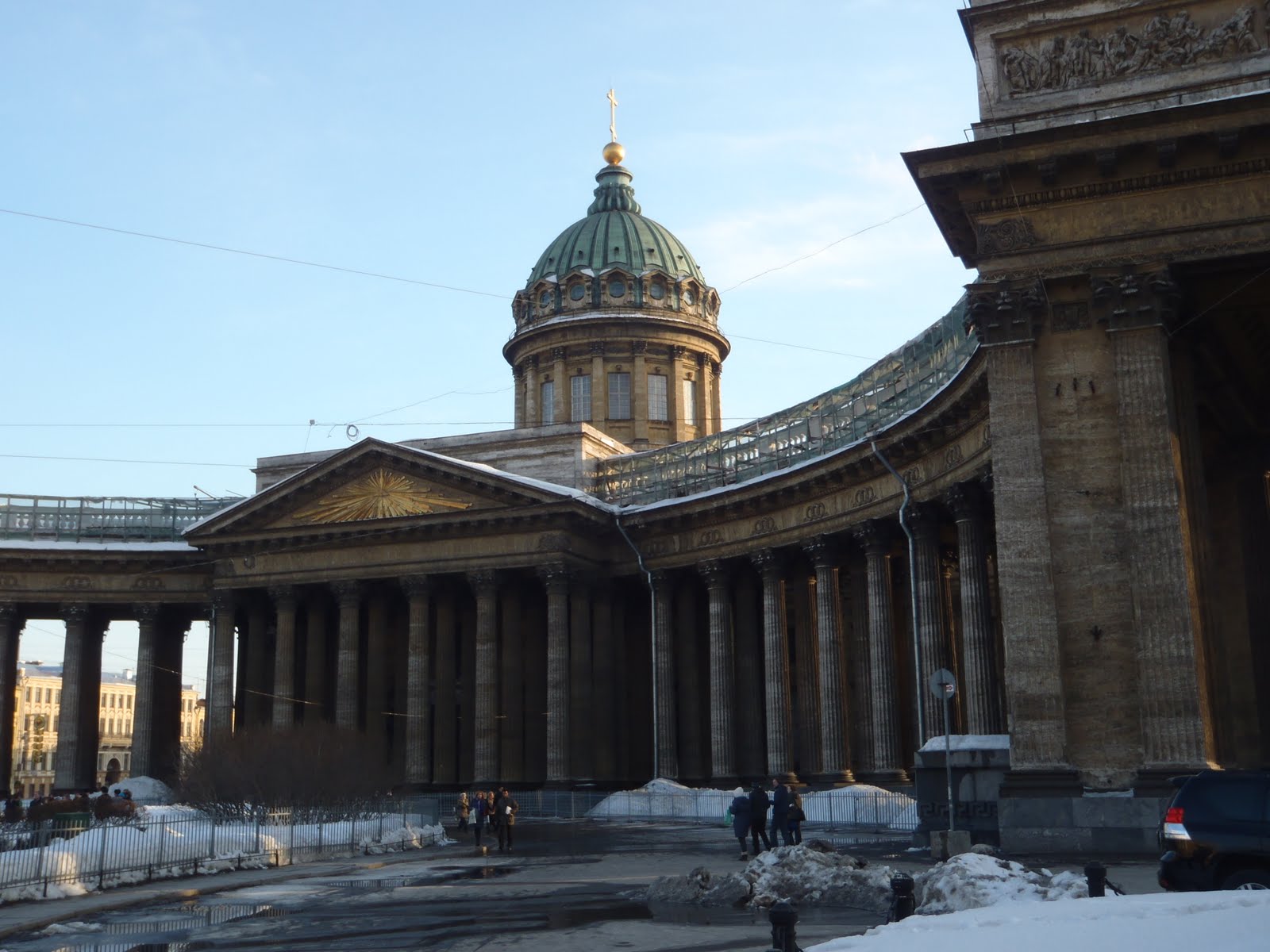
96 - the number of columns in the Kazan Cathedral. This Cathedral resembles the Vatican's St. Peter's on the outside but it awkwardly situated in the middle of fashion and shopping area on Nevsky Prospkt.
2.5 million - the number of annual visitors to the Hermitage Museum. With nearly 3 million items in the collection, this is definitely a place that we'll need to visit again! Despite spending an entire 8 hour day wandering the rooms and going on two guided tours of the Diamond and Gold rooms, the Hermitage's six buildings (four of which we were allowed to visit - Winter Palace, Small Hermitage, Old Hermitage and New Hermitage) comprise about 120 rooms that were filled with archeological artifacts, art work from the 13th-20th centuries, and many gifts to the Russian tsars (or looted during the war from the Germans). In part, because this museum was the Winter Palace of the tsars, the ornate decorations made it the most impressive museum I have ever been to. It was the equivalent of the Vatican Museum, British Museum, and more in one! I was overwhelmed and extremely impressed to say the least. Next week we are headed to the Musee D'Orsay and Louvre which will be impressive as well but I doubt they will surpass the Hermitage.
A foreigner invited to one extravagant event in the Winter Palace in 1778 wrote: "The wealth and opulence of the Russian court exceed the most fanciful description… The sumptuous brilliance of the court apparel and the abundance of precious stones leave the magnificence of other European courts behind".
Monday, March 21, 2011
Joensuu and the North Karelia Project
The city of Joensuu (pronounced "youn-soo") is a modest town of 75,000 people in the region of North Karelia.
The Non-Communicable Disease Seminar participants, Seth, and I traveled by train for five hours (440 km) north through large pines forests and fresh white snow to North Karelia. One could easily confuse this place for a town in northern Minnesota and I suppose that's why the Finns and Swedes settled in Minnesota - they were good lumberjacks, they could survive the cold winters, and they love to ski!
The first day in Joensuu, we visited the headquarters of the newspaper, Karjalainen. They are the largest daily newspaper and reach over 80% of the population in the area everyday. "How can that be?" you might ask, well the Finns not only consume the most coffee per capita, but they read print newspapers the most too - 34 minutes daily per person! They have 32 daily newspapers and 166 non-daily in a country of only 5.4 million people. They told us about the partnership that they have with the North Karelia Center for Health to promote healthy behaviors and develop a "reality" show of 8 people trying to be healthier - quitting smoking, exercising more, and eating more fruits and veggies. They use journalistic flavor to appeal to the readers and promote healthy lifestyles.
(Katie standing outside the Joensuu City Hall where our international crowd met the Mayor and Regional Council members.)
Hospital visit
Next we visited a primary health center which was very nice but only had 10 clinicians for 150 beds and none who worked the night shift. Not sure I'd ever want to get seen there but alas, they assured us that nurses take on a lot more responsibility here and manage most of the chronic disease management and screening visits and that most of the beds are long-term beds, aka nursing home type, and have six-month waiting lists. A doctor is available by phone and all emergencies are transfered to the Central Hospital in the next town where specialists were covering 24/7. Nurses and doctors are civil servants here, like teachers and politicians, and are not compensated well. Most doctors in this area work in private practice.
Taxes
The Finns spend 46% of their income on taxes! However, they spend half as much as we do ($2331 vs. $5401 per capita) on healthcare per capita. Nearly 100% of babies are born in hospitals and their infant mortality rate is the second lowest in the world to Norway. Healthcare is mostly free in Finland ($12 per visit and minor medication fees). The school system is amazing! They are one of the most literate countries in the world and their schools include a free home-made balanced lunch for all students up to grade 9, free transportation if you live over 3 miles away, and free university tuition. All of their teachers must have a Masters in Education.
Folk singing
That night, the Finnish Heart Association invited us to a special meeting in the next town over. While we were on the bus, I got a phone call from my Dad who had attended my Match Day Ceremony where I found out that I matched at the University of Washington - Seattle for Internal Medicine. I was giddy waiting for the call and nearly in tears when we found out because we were so happy!! When we arrived at the meeting, we were greeted by a choir and soloist who sang "songs about the heart" they said. There were speeches in Finnish by the president of the association, our hero in cardiovascular disease prevention, Pekka Puska, and the town leaders. Then, we had to stand in front of everyone and introduce ourselves and afterwards a few people came up to us but did not speak any English so we had to pull over one of the Finnish participants to translate. It was a great evening and Seth and I celebrated with our new Australian, Nigerian, Bahranian, and Finnish friends over dinner and wine in the hotel afterwards!
(Photos will be posted later)
Back in Helsinki
Helsinki is the northernmost urban area of a population over 1 million, and there is much to do and see in terms of it's design business and history, starting with the centrally located Senate Square and Lutheran Cathedral. The master of the Finnish Art Nouveau was Eliel Saarinen (1873–1950), whose architectural masterpiece was the Helsinki central railway station and the city hall in Joensuu (photo from above).
If it's too cold, you could always spend a day getting lost while shopping in the eight-floor department store, Stockmann's!
St. Petersburg
Seth did not mention how wonderful the styles of the women is here - furs, furs, black tights and boots! Men are dressed in less stylish but still warm fur hats and wool coats, and some even carry leather purses. It's wonderful and cracks me up every time we leave the hotel. More blogs to follow about the Hermitage who's director once said "We can't say we are the #1 art museum in the world, but we aren't #2." We plan on spending all day there tomorrow. Thanks for reading!
Sunday, March 20, 2011
St. Petersburg to Petrograd to Leningrad to St. Petersburg
Wednesday, March 16, 2011
Helsinki
Katie and I packed in a lot in those days going to museums, visiting markets, exploring the City on self-guided walking tours, and taking the ferry to Suomenlinna – the City’s Maritime Fortress. Helsinki is a great starting point for our trip as English is widely spoken, the City is small and intimate, and we can get our “traveling to foreign land” legs under us. In addition, we learned a lot about the history of the region, a history I was very ignorant of before coming here. For example, did you know that Helsinki was considered Axis-Lite? While they didn’t fight alongside the Nazis, they did receive arms for allowing the Nazis to move through Finland to occupy Norway. Due to this assistance, as war reparations Finland lost a large portion of Karelia to Russia.
(KTP keeping her eye out for the pesky Russians)
One downside to this trip is traveling during the tourist offseason. Time and time again I have been thwarted as many museums, parks, and tourist sites are closed for repairs or to change exhibitions. This has been frustrating, and hopefully we don’t run into that issue in such a major way again.
We are off this afternoon to Joensuu as part of Katie’s training. The trip is about 440 kilometers and about halfway from Helsinki to the Arctic Circle. By looking at maps, I am guessing that it will look a lot like northern Minnesota - plentiful lakes amid the pine/spruce trees. We come back on Friday, and then head to St. Petersburg on Saturday.
* As this is my first post, there are still some blogger.com nuances I need to figure out. One are pictures and possibly appropriate sizing - so please bear with me.
Tuesday, March 15, 2011
Making the healthy choice the easy choice
The Non-communicable Disease Training Seminar in Helsinki, Finland is fantastic! I highly recommend it to anyone who is interested in public health and population-based interventions for chronic diseases. It is based on the North Karelia Project that took a truly population-based approach to treat cardiovascular disease (CVD) in a population of lumberjacks and farmers that were dying at a young age of CVD. They were the folks who claimed, "Veggies are for rabbits" and said "I'll have some bread with my chunk of butter, kiitos (thank you)" who consumed 40 pounds of butter per year! Therefore, their diet (and tobacco use) contributed to their high cholesterol, blood pressure and mortality rates in the 1970s. Simple interventions - smoke-free workplace campaigns, margarine for butter, substituting skim milk for whole milk in schools, increased vegetable subsidies and consumption, and increased physical activity - made a dramatic difference for this community.
Who are we?
I am one of two people from the USA attending the seminar, which thankfully is held in English. There are 24 of us who come from all over he globe: Tanzania, Ethiopia, Thailand, Iran, Finland, Japan, UK, Australia, Bahrain, and the USA. The goal of the seminar is to discuss theories and share ideas for us to bring back to our countries or institutions in order to promote prevention. Specifically, the World Health Organization has emphasized four factors: tobacco, diet, exercise, and alcohol use. I've said it before, but let me re-emphasize, the global burden of cardiovascular disease is HUGE! Eighty percent of all CVD is in developing countries. The costs of pain and suffering from both chronic and infectious diseases are disproportionately affecting the poor. Many of the deaths from these causes are avertable - either preventable or treatable. Building cath labs is not going to solve this problem. Prevention is the only sustainable, affordable, and feasible public health intervention that has been shown to decrease this epidemic and decrease other chronic disease as well as delay or post-pone mortality so that people can live more healthy, productive lives and contribute to development and decreasing poverty in their countries. Often, the factors that contribute to disease are outside of the control of the individual and are deeply rooted in society (socioeconomic, cultural and environmental factors).
Get Healthy Before Wealthy
Some argue that helping get people out of poverty - for example, providing clean water, sanitation, and education - would improve their health so why bother with chronic disease management? Well, the truth is development is slow to decrease poverty and not real effective for improving health. If we help strengthen the health systems and make people healthier now, they in turn will do more to help improve development and decrease poverty.
In a nutshell
How to start a prevention program? First, involve the stakeholders, policymakers, and community as managers and directors of programs from the beginning. Then, use working groups to try to understand all the health and non-health existing resources and challenges in the community. Then, target the primordial, primary and secondary interventions using medical and social behavioral methods. Examples include individual behavorial changes like quitting smoking to lifestyle changes in the community, like smoke-free campaigns. Improving nutrition, encouraging physical activity, and improving medication adherence for treatment of disease are also important interventions. Finally, building infrastructure to treat the high risk people in the community.
"Make the healthy lifestyle the easy one."
Successful programs are those that are multi-dimensional, target the whole population, complement initiatives in place, are sustainable, and have adequate time and funding to complete the intervention(s). In all cases, making the healthy lifestyle or behavior the easier choice is key for a sustainable and effective intervention program. If only we could do this in the US too!
"Only those who see the invisible can do the impossible."
Friday, February 25, 2011
Mr. and Mrs. Benziger!
We had a wonderful time with 90 of our closest friends and family over the past 12 days in Costa Rica. It was wonderful to have so many people join us in paradise for a little bit of everything: hiking, zip lining, and hot springs in Arenal to salsa dancing, surfing, and sailing at sunset in Tamarindo.
Thursday started with a group catamaran sailing trip on the Marlin del Rey. It was the best and biggest sail boat ride ever! We knew everyone on the boat (which made it so much more fun) and we were dancing, sunbathing, swimming and keeping the bartenders busy for 5 hours.
On Friday, Seth's parents hosted a delicious groom's birthday dinner at Dragonfly in Tamarindo - arguably the best restaurant in all of Costa Rica - fresh tuna fillets, salmon and tempura tuna sushi, linguini and raviolis, mashed potatoes and veggies and cake. The bar was busy there, too! After dinner, the owner surprised us with a live band and so everyone went outside and danced barefoot in the sand until our feet hurt and the place closed down. It was awesome!
Katie with the Peruvians who made the trip "Up North" for the wedding!
But the highlight for me was definitely saying our "I do's" on Saturday evening on the Tamarindo beach and then being serenaded by the latino trio singing "Besame." The wedding was fantastic - 1,000 times more perfect than I had planned! Everything from the orchids in my bouquet to the playlist we threw together to the birds of paradise centerpieces to the buffet and lactose-free cake - it was all perfect! At the end of the night, just about everyone got thrown or jumped in the pool (the groom was thrown in first and broke his glasses). Even my mom and I jumped in, hand in hand and in our dresses.
The ceremony at El Diria in Tamarindo, Costa Rica
Walking into the reception as Mr. and Mrs. Benziger
Katie and JoAnn right before jumping in the pool!
The following week was R&R. We were able to lounge around the pools. Waking up and going out our sunset/ocean view porch to feel the Pacific ocean breeze calling our names. We spent the mornings surfing, boogie boarding or just jumping in the waves. Then we'd walk a mile or more along the beach and watch the slugs and crabs in the tide pools while the pelicans would fly up and dart down into the waves to catch their prey. We'd grab lunch at the swim-up poolside bar and then watch European soccer games all afternoon while basking in the sun. The best part was that every where we went, we'd run into our best friends or family! One day (when we were sick of running into our friends and family) we escaped to the Los Alto de Eros Spa for a couple's massage and romantic dinner. It was the best massage ever and much needed after all the stress of planning a vacation for 90 people and a wedding! After our massage, we were left alone to go in the jacuzzi and watch sunset but we were son interrupted by a dozen HUGE frogs and a few Howler monkeys (and we even saw an armadillo on the drive home). It was amazing!
It was hard to go home yesterday to the 10 degrees F and 18+ inches of fresh snow but it will be a trip that we will never forget and I'm sure we'll go back again soon!
Love,
Katie and Seth
P.S. More wedding photos to follow when I get the originals from our photographer! Here are some from my sister, Anne's Picasa album (click on the photo to see all of them):

Click the photo to see A LOT of great wedding photos by Seth's buddy Chris.
![]() |
| pura vida |
Click the photo to see my brother Dan's Picasa photos.

Click the photo below to see lots of photos from my bridal showers and some wedding photos from my mother, JoAnn: